Every year, sometime in the first week of February, the Finance Minister of India walks into Parliament carrying a red briefcase. What follows is a two-hour speech that will determine how the government spends approximately Rs 48 lakh crore - and will directly or indirectly touch every salary, every tax slab, every industry, and every job opening in the country.
Most students watch the coverage for about twenty minutes and then go back to studying for their next exam.
This is a mistake - and not a small one.
What the Budget Actually Is
The Union Budget is the government of India's annual financial plan. It has two sides:
- Revenue: Where the money comes from - income tax, GST, corporate tax, customs duties, borrowings.
- Expenditure: Where the money goes - defence, infrastructure, education, subsidies, interest payments on debt.
The gap between these two - when spending exceeds revenue - is called the fiscal deficit. The size of this deficit matters enormously: it tells you whether the government is borrowing responsibly or piling up debt that will eventually squeeze future spending and raise interest rates.
But beyond these basics, the Budget is also a signal. Every allocation tells you something about where the government believes growth will come from and which sectors are about to get a tailwind - or a headwind.
Why It Directly Affects Your Career
You might think the Budget is about big macroeconomic numbers that do not touch your day-to-day life. Here is why that is wrong.
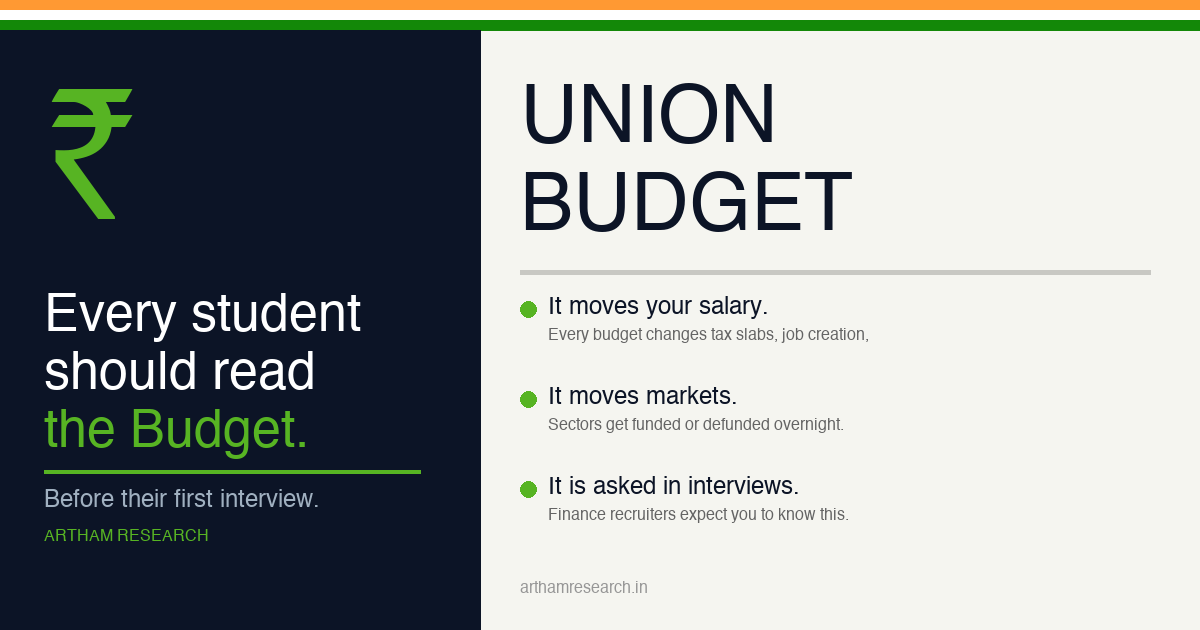
Tax slabs move your take-home salary.
The income tax slabs announced every year determine how much of your salary you actually keep. In recent budgets, the government has been actively incentivising the new tax regime - reducing rates for people in lower and middle income brackets. Whether you opt for the old or new regime, and how you structure your savings to minimise taxes, is a decision that requires understanding what the Budget actually said.
Budget allocations determine where the jobs are.
When the government announces a Rs 10 lakh crore capital expenditure on infrastructure, it is not just building roads and railways - it is creating hundreds of thousands of jobs in construction, logistics, engineering, finance, and related services. When defence gets a massive budget increase, HAL, BEL, L&T Defence, and Mazagon Dock start hiring. When digital infrastructure is prioritised, IT services and cloud infrastructure companies grow. The Budget tells you where the next wave of corporate hiring will come from - often 12 to 24 months before the job postings appear.
Sectors the Budget kills are sectors you do not want to bet on.
Conversely, sectors that face new taxes, reduced subsidies, or regulatory tightening tend to pull back on hiring. The students who understand this are the ones who can make smarter career decisions - choosing sectors with government-backed tailwinds rather than industries in regulatory trouble.
What Gets Asked in Finance Interviews
If you are targeting any finance-adjacent role - banking, investment management, consulting, NBFCs, insurance - you will almost certainly be asked about the Budget in your interview.
The questions are not exotic. They are things like:
- "What do you think was the most significant announcement in the Budget this year?"
- "How do you think the fiscal deficit target will affect interest rates?"
- "Which sector do you think stands to benefit most from this Budget?"
These are opinion questions, which means there is no single right answer. But there is a very visible wrong answer: "I have not really followed it closely."
In a room full of candidates for an analyst role at a bank or a consulting firm, the one who can speak fluently about fiscal policy, tax changes, and sector implications stands out immediately. And that fluency does not come from reading one article the night before the interview - it comes from following the Budget every year and building the mental model over time.
How to Read the Budget Without Getting Overwhelmed
The full Budget document runs to hundreds of pages. You do not need to read all of it. Here is a practical framework:
1. Follow the top-line numbers first.
Total expenditure, revenue receipts, fiscal deficit as a percentage of GDP, and the capex number. These four figures tell you the broad story in thirty seconds.
2. Read the sector-by-sector allocations.
Education, health, infrastructure, defence, agriculture, rural development - where did allocations increase and where did they fall? This is where the jobs story lives.
3. Focus on the tax changes.
Income tax slabs, corporate tax rates, customs duties on key imports - these signal which industries are being protected or exposed to competition.
4. Read two or three quality analysis pieces.
Not the political commentary - the economic analysis. The Reserve Bank of India, CRISIL, ICICI Securities, and major business publications typically release structured Budget analyses within 48 hours. These are more useful than the live speech for building understanding.
5. Form one clear opinion.
Pick one thing that you found genuinely interesting or surprising. Be able to explain it and defend your view. This is what interviewers actually want to see - not that you read the Budget, but that you can think about it.
Start This Year
The Union Budget is presented every February. If you start following it now - even at a basic level - by the time you face your placement interviews in a year or two, you will have built a vocabulary and a framework that most of your peers simply do not have.
That is not a minor edge. In finance roles where dozens of candidates share similar credentials, the ability to speak intelligently about fiscal policy is exactly the kind of differentiator that makes a hiring decision swing your way.
Build the full financial vocabulary for your interviews.
ELEVATE helps students bridge the gap between textbook knowledge and what companies actually look for - including the macro and policy understanding that finance roles demand.