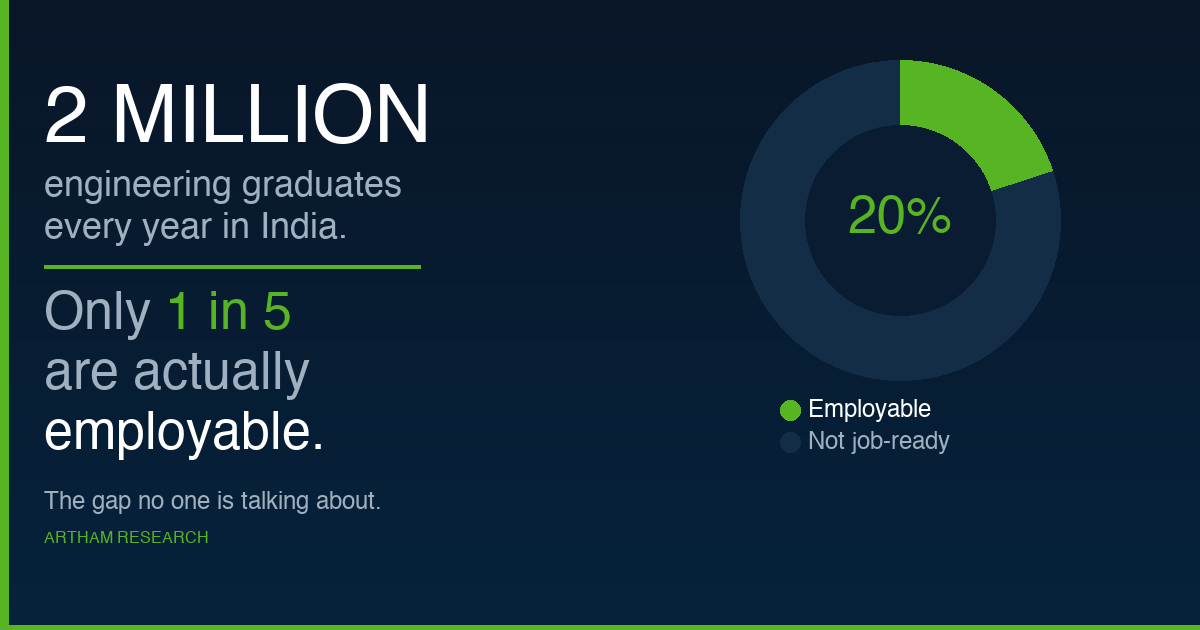
India produces more engineers than any other country in the world. Two million every year. That is a staggering number - roughly the combined population of cities like Chandigarh and Thiruvananthapuram entering the job market annually with a degree in hand.
And yet, multiple studies - from NASSCOM, Aspiring Minds, and the India Skills Report - consistently find the same uncomfortable truth: fewer than 20% of engineering graduates are employable in any meaningful role related to their degree.
That means four out of every five students spend four years, pay lakhs in fees, and emerge from college genuinely unprepared for the jobs they applied to study for. This is not a small problem. This is a structural crisis - and it is playing out quietly on every college campus in the country.
Why the Numbers Are So Bad
The answer is not that Indian students are unintelligent. Visit any IIT or NIT campus and the intellectual firepower is obvious. The problem runs deeper - it lives in the design of the system itself.
Indian engineering education was built to produce exam-passers, not problem-solvers. The curriculum was designed decades ago and has not meaningfully updated to match what industry actually needs. In most colleges, the assessment system rewards memorisation. A student who can reproduce a textbook answer in an exam scores higher than a student who actually understands the concept but cannot recall the exact phrasing.
Meanwhile, the industry has moved. Today, companies hiring fresh engineers do not just want someone who knows the theory. They want someone who can:
- Write clean, working code - not just describe how code should work
- Debug under pressure and collaborate on large codebases
- Communicate clearly with non-technical stakeholders
- Understand business context, not just technical specifications
- Learn on the job, adapt to new tools, and work without constant hand-holding
None of these skills are part of most engineering curricula. They are acquired through projects, internships, competitions, and environments where failure has real stakes. Most students simply never encounter that environment until after they graduate - and by then, the interview has already happened.
The Tier Gap Makes It Worse
There is a tier problem layered on top of the curriculum problem. India has approximately 4,000 engineering colleges. Perhaps 50 to 100 of them - the IITs, NITs, top private institutions - have strong placement infrastructure, industry connections, and alumni networks that help bridge the employability gap.
The remaining 3,900+ colleges send students into the job market with a degree, a handshake, and very little else.
Students from tier-3 colleges are not less capable than their IIT counterparts. But they have had far fewer structured opportunities: fewer internship connections, weaker alumni networks, no dedicated placement training, and faculty who are themselves disconnected from industry realities.
The tragedy is that these are often the students who need support the most - those who are the first in their family to get an engineering degree, who took on debt to get there, and who cannot afford to spend two more years figuring out what college should have taught them.
The Three Gaps That Matter Most
When you break down the employability problem, it consistently comes down to three specific gaps:
1. The Technical Application Gap
Students know theory but cannot apply it. They can tell you how a sorting algorithm works but cannot write one without looking it up. They understand networking concepts but have never configured a server. Knowledge without application is not skill - it is trivia.
2. The Communication Gap
Technical skill alone does not get you hired. Every interview - even a purely technical one - requires a human being on the other side of the table. Can you explain your thought process? Can you say "I do not know but here is how I would find out"? Can you handle pressure without freezing? These are the moments that decide most hiring decisions, and they are almost never practised.
3. The Workplace Readiness Gap
Most fresh graduates have no idea what a corporate environment actually looks like. How do you write a professional email? How do you push back on a deadline respectfully? What does ownership mean in a team context? These are skills that take years to build on the job - but the candidates who arrive with even a basic understanding of them are immediately more valuable.
What Needs to Change
The root-cause fix is a curriculum overhaul - more project-based learning, compulsory internships with real companies, updated syllabi co-designed with industry. Several IITs and the newer IITs are moving in this direction. But curriculum change takes a generation. It moves through approvals, accreditations, and institutional inertia. The students graduating today cannot wait for that.
What can change immediately is the ecosystem around the curriculum. Community-driven mentorship, structured soft skills training, guided project building, mock interview environments run by people who have actually hired - these are interventions that work right now, without waiting for colleges to restructure themselves.
What You Can Do
If you are an engineering student reading this, the first step is an honest assessment of where you actually stand. Not where your marks say you stand - but where your skills stand. Can you build something from scratch? Can you explain what you built clearly? Have you ever sat across from someone who challenged your answers?
If the answer to any of those is uncertain, you still have time. But you need to find the right environment to close those gaps - and that environment is rarely inside your college building.
ELEVATE was built specifically for this gap. It is a community of students, recent graduates, and industry mentors working together to make the next generation of candidates genuinely employable - not just degree-holders. The programme is structured, mentorship is real, and it costs nothing to begin.
Because fixing this problem at scale requires people who have been through it to come back and help the next batch. That is the only way the numbers start to change.
Want to close the gap before your next interview?
ELEVATE is a free, community-driven programme that prepares students end-to-end - from technical foundations to interview day. Built by seniors who were once in the same position and chose to come back.