Every year, thousands of Indian students spend months preparing for placements. They clear the aptitude tests. They pass the online screening rounds. They get that email saying "Congratulations, you have been shortlisted for the interview."
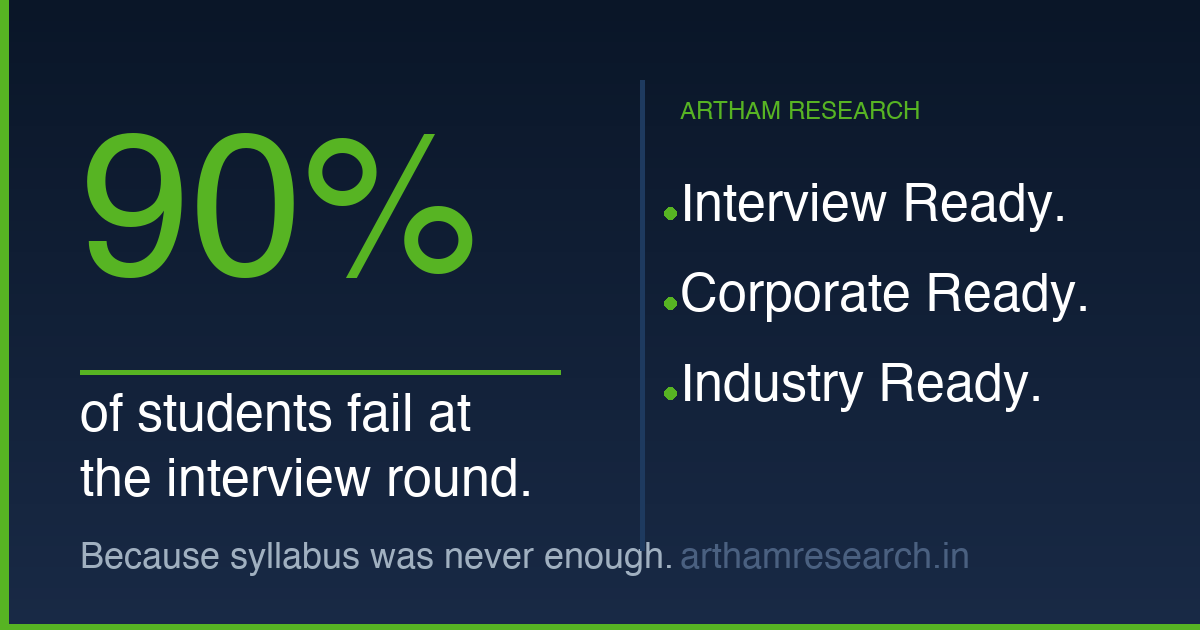
And then 90% of them don't make it past the interview.
Not because they lack intelligence. Not because they didn't work hard. But because everything they prepared for - the syllabus, the certifications, the mock tests - was training them for the wrong finish line.
The Problem Nobody Talks About
Walk into any college campus and you will find students buried in CFA prep materials, NSE certification books, and CA modules. These are valuable. Nobody is saying they are not.
But here is what companies actually evaluate in an interview:
- Can you think on your feet? When the interviewer throws a case or a situation at you, do you structure your thinking or do you freeze?
- Can you communicate? Not just speak English - but articulate ideas clearly, handle follow-up questions, and hold a professional conversation under pressure.
- Are you workplace-ready? Do you understand professional norms, email etiquette, how to work in a team, how to take feedback?
- Do you know your own resume? Most students list projects and internships they cannot speak about for more than 30 seconds.
None of these are taught in your syllabus. None of these are tested in a certification exam. And yet every single one of them decides whether you get the offer.
Why Syllabus Preparation Fails at the Interview Stage
Syllabus preparation is designed to test knowledge retention. You study a topic, you answer questions about it, you score marks. This is a closed system with known answers.
Interviews are open systems. There are no model answers. The interviewer is not checking what you know - they are checking how you think, how you handle uncertainty, and whether they would want to work with you.
This is a fundamentally different skill set. And it requires fundamentally different preparation.
The students who crack interviews are rarely the ones with the highest marks. They are the ones who have practised speaking about their ideas out loud. Who have been in rooms where they had to answer tough questions and come back for more. Who have been given honest feedback and used it to improve.
That environment does not exist in most colleges. You have to find it or build it.
What Interview-Ready Actually Looks Like
Here is what separates the students who clear interviews from those who do not:
1. They know how to tell their story.
"Tell me about yourself" is the most common interview opener and the most commonly fumbled. Interview-ready students have a crisp, confident answer that connects their journey, their skills, and why they are sitting in that room.
2. They have practised under pressure.
Not alone in front of a mirror - in front of people who ask follow-up questions, who challenge their answers, who simulate what a real interviewer feels like. Discomfort in practice means composure in the real thing.
3. They understand the professional world before entering it.
They know what a corporate hierarchy looks like. They know how to write a professional email. They know what "initiative" and "ownership" mean in a work context, not just as buzzwords on a resume.
4. They have received brutal, honest feedback.
From mentors who have been through it - not from friends who will tell you that you did great. Growth happens at the edge of discomfort, and most students never reach that edge before their first real interview.
The End-to-End Gap
Most coaching and preparation programmes have an entry point and an exit point. You pay, you attend, you get a certificate. What happens to you after - whether you actually get placed - is not their concern.
This is the fundamental gap in how we prepare students in India.
Real preparation is not a course. It is a process. It starts with building your fundamentals, moves through real application and practice, and ends only when you have the offer in hand. Everything in between - mock interviews, resume reviews, industry exposure, mentorship sessions, HR round preparation - is part of the same journey and needs to be treated as such.
What Artham Research and ELEVATE Are Doing About It
ELEVATE was built specifically to close this gap.
Not as a coaching centre. Not as a certification programme. As a community-driven employability movement that takes students from where they are to where they need to be - Interview Ready, Corporate Ready, and Industry Ready.
The mentors inside ELEVATE are not paid faculty. They are seniors who have been through exactly what current students are facing. They cleared the interviews, joined the companies, and came back to make sure the next batch does not have to figure it all out alone.
This is the #PayItForward model. Every student who gets placed is expected to come back and contribute to the next batch. No fees, no formal obligations - just the belief that the best way to honour the help you received is to pass it on.
"The students who fail interviews are not failing because they are not smart enough. They are failing because nobody ever prepared them for what an interview actually tests."
If you are a student reading this and wondering whether you are truly prepared - not just for the screening test, but for the room where the decision is made - ask yourself honestly:
Have you spoken about your work out loud to someone who pushed back? Have you been told what your weaknesses are by someone who has hired people before? Do you know what you would say if someone asked why they should hire you over the other 200 candidates?
If the answer to any of those is no, the preparation is not done yet.
ELEVATE is open. The community is real. And it costs nothing to begin.